
"A child is born with unlimited potential. The task of adults is not to forbid him, but to switch his attention to something more useful, shovel-less, attractive".
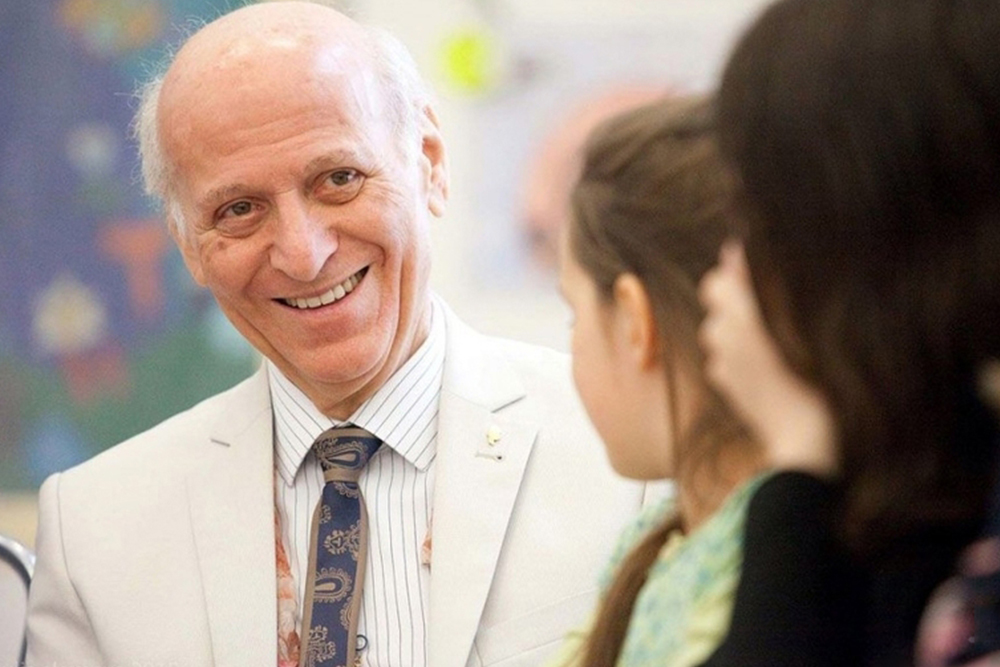
Shalva Amonashvili (8.03.1931) - Professor, Doctor of Humanities, leading scientist in the field of pedagogical psychology.
Education
In his hometown he received the higher education at the Tbilisi State Institute, studying at the Faculty of Oriental Studies. He completed his postgraduate studies at the scientific research institute named after Y. S. Gogebashin in 1958 and two years later defended his scientific work, receiving the degree of Candidate of Pedagogy. Soon after, in 1972, he received the degree of Doctor of Science in Pedagogical Psychology at the Dissertation Council of the Institute of General and Pedagogical Psychology.
Career
From 1955 he worked at the Georgian Research Institute of Pedagogy, and in 1983 he got the position of a dean there.
In 1991 he was the head of the department at the Pedagogical University named after S.S. Orbenia. S.S. Orbenialli.
Since 1988 and up to now he has been working as a leading specialist in the laboratory of the Moscow State Pedagogical University.
Scientific interests
Shalva Amonashvili developed the ideas of humanistic-personal approach of pedagogy. This direction is focused on the personality of the child, there is a complete rejection of authoritarian upbringing. The whole process of education is built on the understanding and acceptance of the teacher of all the features of child development.
In his approach, the author emphasized the main attitudes:
1. The teacher should love and understand the child.
2. The main qualities of a teacher are kindness, devotion, openness.
3. Teaching a child consists in striving for development, freedom and independence.
4. The main principles in the work of the teacher are respect for the child's personality, patience in the process of education, creating a favorable environment around the child.
What is the essence of humane pedagogy?
The leading goal of humane pedagogy is the education of a worthy person. Amonashvili states: "The educational process can be considered humane if:
- We show the child the world of kindness, respect, compassion, sincerity, patience.
- We will direct their attention to their inner spiritual world.
- We will develop in them noble deeds, responsibility for their actions and words.
- Encourage them to cognition, rational attitude to difficulties, desire to search for new information".
Pedagogical ideas
"Wishing to discover the mystery of a child's soul, with the help of my own skill and pedagogical science, I strive to see in every pupil his educator and teacher."
"Any educator who gives a lesson, immediately receives a lesson himself."
Parable "One" by Shalma Amonashvili
One cold winter evening an old woman could barely stand at the counter, she was hunched over glancing indifferently. People passing by had the impression that she was ill with something. Snow was falling and a strong wind was blowing. The old woman's look for help appealed to a passersby, her hands were pointed forward, and she whispered quietly:
- One thing... Please... I ask for nothing more.
That evening, her hope was leaving her, as was the warmth in her arms.
Suddenly, a young man running by held out a coin to her.
- No, no.... I don't need money...' she uttered.
- And why are you standing here? - The young man asked.
- Won't you give me one, just one kind word?
- A kind word? - The man was surprised.
At that moment he remembered his beloved grandmother, who read him fairy tales as a child and soon passed away. Then he thought to himself: "What if it is my grandmother who has come back?"
He put her skinny and frozen hands, held them for a few minutes and tried to warm them. Afterward he kissed the palms gently and said:
- My grandmother, I love you....
At that moment a smile appeared on her face and she shone with happiness.
- Thank you, grandson, it will be enough for me for a long time... - she whispered and went away.