
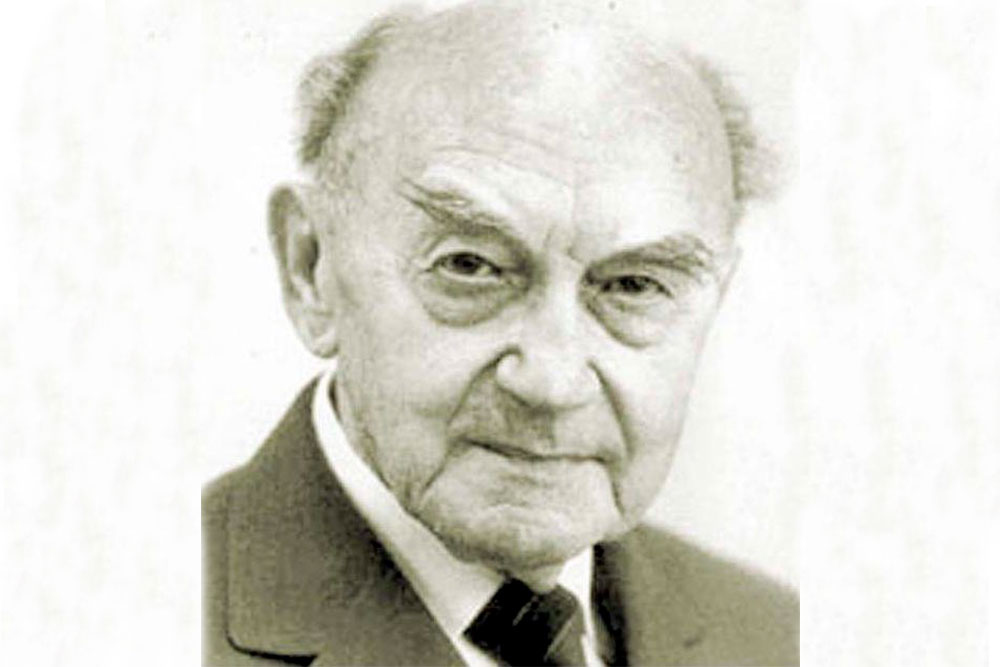
As a prominent German psychologist, Karl Leonhard made significant contributions to the development of the study of schizophrenia, neuroses, and other psychological pathologies. His fundamental research played a key role in the evolution of views on psychiatry, not only in Germany but also abroad. Karl Leonhard actively collaborated with scientists from the USSR, had a deep knowledge of the domestic professional literature and regularly published his scientific works in different languages, demonstrating his openness to international scientific dialog.
Biography
Karl Leonhard was born in 1904 in Bavaria into a family with deep religious roots - his father was an evangelical priest. Up until the age of 19, Karl dreamed of a career as a lawyer, studying at a gymnasium with a humanitarian profile. However, eventually his life path underwent a radical change - he refocused on medicine. After graduating from university, Leonhard identified his vocation in the field of psychiatry and devoted his entire life to this field.
Already at the age of 28, a year after he began practicing, Leonhard took the post of chief physician in a psychiatric hospital. In 1937 he earned his doctorate, which opened the door to an academic and teaching career that began in 1944. The following years were marked by the change of several universities where he shared his knowledge, until in 1957 he joined the team of the famous Charité Clinic, associating a significant part of his career with it.
Intensively studying schizophrenia, its classification and clinical aspects, including diagnosis in childhood, Leonhard made significant contributions to the understanding of the disease. He also conducted research on behavior therapy, psychosis, and the psychopathology of human behavior, leaving behind numerous publications on these topics.
Despite being widely recognized in the international scientific community and being a member of the All-Union Scientific Society of Neurologists and Psychiatrists, many of Leonhard's ideas were met with misunderstanding and criticism from his contemporaries, which, however, did not stop him from pursuing new discoveries.
Accentuated personality
An in-depth study of character accentuation led to the creation of an extensive two-volume monograph, The Accentuated Personality. In this work, Leonhard first introduced the concept of "accentuated personality", which is understood as a pronounced, sometimes bordering on the norm, character or personality trait. The first volume is devoted to a thorough analysis and description of this phenomenon, while the second volume is supplemented with "living" examples from classic literature, including works by Tolstoy, Gogol, Shakespeare, Balzac and many others.
Leonhard divided accentuations into 10 basic types, differentiating them according to the nature of their origin - acquired or innate.
Character-dependent (acquired)
Demonstrative
This type of person tends to draw attention to themselves, likes to be in the epicenter of events, often shares personal experiences and achievements, not hiding their boastfulness.
Stuck
A distinctive feature of such personalities is a long memorization of offenses, which "get stuck" in their memory, causing a desire for revenge and repeatedly reliving situations of conflict.
Pedantic
Cautious and indecisive, such people avoid change, preferring stability and order, demanding the same from others.
Excitable
The main trait is impulsiveness and impatience. In excitable personalities rational thinking often gives way to uncontrollable impulses and desires.
Dependent on temperament (congenital)
Hyperthymic
Energetic and optimistic, such people enjoy life and socializing. They easily overcome difficulties while maintaining a positive attitude.
Dysthymic
They are complete opposites of the hyperthymic type, tend to see the world in dark colors. Expect to be deceived, so they do not trust others, showing seriousness and passivity.
Exalted
Extremely impressionable, experience emotions in extremes - from explosions of joy to deep feelings of sadness.
Anxious
Characterized by insecurity and a tendency to exaggerate the slightest problems, which leads to excessive reticence and shyness.
Cyclothymic
This personality type experiences alternating periods of emotional highs and lows, exhibiting unrest and emotional fluctuations.
Emotive
Responsive and empathetic people who can deeply empathize with another's pain, experiencing emotions at a very deep level.
Testing
An analog of the Schmischek Questionnaire, based on the legacy of Karl Leongard, is available on our website. The original questionnaire, developed by Hans Schmischek in 1970, consists of 88 questions requiring an intuitive yes or no answer. Our adaptation of the test consists of 60 questions and offers a choice of five answer options, allowing for a more accurate assessment of the presence or tendency toward character accentuation. Determine the presence of or tendency toward character accentuation by taking the online test on our website.